Blake Becker · 27 September 2026
Shifts in Peer-to-Peer Resource Allocation Models Reshaping Community Interactions Across Tavford's Digital Spaces
Understanding the Transition in Tavford's Digital Frameworks
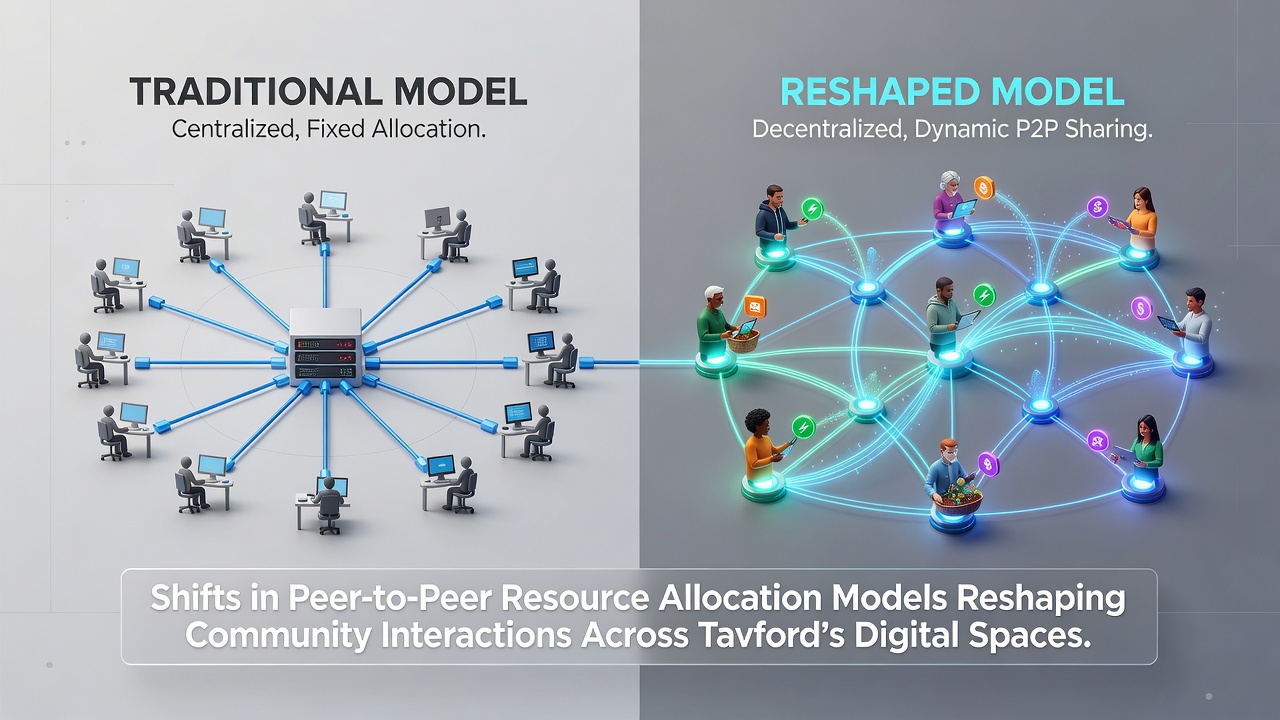
Communities across Tavford have relied on peer-to-peer resource allocation for sharing bandwidth, local data storage, and collaborative tools since the early development of regional digital platforms, yet recent model adjustments have introduced new distribution protocols that prioritize algorithmic matching over direct user exchanges. These changes emerged gradually through platform updates that integrated decentralized ledgers and dynamic priority systems, allowing resources to flow based on real-time demand signals rather than fixed user agreements.
Observers note that traditional setups often depended on manual matching where participants listed available resources and waited for connections, whereas newer frameworks use predictive analytics to pre-allocate capacity during peak periods. Data from regional network analyses indicate these adjustments reduced idle resource times by measurable percentages in monitored districts, while simultaneously increasing the frequency of cross-group collaborations within digital forums.
Key Drivers Behind Allocation Model Updates
Platform operators in Tavford began testing revised allocation engines in late 2025, incorporating elements such as reputation-weighted bidding and automated escrow mechanisms that draw from transaction histories across multiple community nodes. A report issued by the OECD on digital platform economies highlights how similar transitions in various regions have altered interaction patterns by encouraging shorter, task-specific partnerships instead of long-term resource pools. Those who've tracked Tavford's systems report that users now receive suggestions for resource pairings that align with activity logs rather than personal networks.
Regulatory guidance released in early 2026 further shaped these developments when authorities emphasized transparency requirements for allocation algorithms, prompting several local platforms to publish their matching criteria openly. This move coincided with infrastructure upgrades that supported higher volumes of concurrent peer connections, enabling more granular resource slices to circulate among participants.
Impacts on Daily Community Exchanges
Residents engaging with Tavford's digital spaces have encountered shifts in how they form temporary alliances for shared projects, with many noting that allocation decisions now surface through notification systems instead of forum posts. Research conducted by the University of Melbourne's Centre for Digital Society demonstrates that communities adapting to these models often experience expanded participation from previously inactive members, because automated systems surface opportunities that manual searches previously overlooked.

Interaction logs collected between March and September 2026 reveal a rise in multi-party resource contributions, where single allocations support simultaneous use by several groups rather than exclusive handoffs. Such patterns have encouraged the formation of fluid sub-communities that dissolve and reform based on project cycles, reducing the dominance of established clusters that once controlled larger resource shares.
Case Examples from Tavford Districts
One northern district implemented a pilot program using hybrid allocation that combined user preferences with system-optimized routing, resulting in documented increases in cross-neighborhood data sharing events tracked through platform metrics. Participants in this area reported streamlined access to specialized tools that had previously required extended coordination periods. Another southern zone focused on storage resource models, where predictive distribution minimized downtime during high-demand windows and allowed smaller community initiatives to secure capacity without competing directly against larger entities.
These localized experiments have produced comparative datasets that platform developers continue to reference when refining algorithms for broader rollout across Tavford's interconnected spaces. Figures released in mid-2026 show consistent growth in active peer nodes, suggesting the revised models sustain higher engagement levels over extended periods.
Conclusion
The evolution of peer-to-peer resource allocation in Tavford continues to influence how digital communities organize and interact, with ongoing refinements expected to address emerging usage patterns. Regional records indicate these adjustments have expanded access points while altering traditional relationship structures, creating environments where resource flows respond more directly to collective activity signals. Continued monitoring by academic and industry observers will track how these dynamics develop through subsequent platform iterations.